


This blog is by Bernadette Crawford as part of Aware Mental Health Week 2026.
Tides Within
I was diagnosed with bipolar disorder in December 2017. Since then, my life has taken many unexpected turns.
Bipolar disorder is a mental health condition that causes significant mood changes, ranging from emotional highs (hypomania or mania) to lows (depression). During depression, brain activity slows; during mania, it speeds up. Around 1–2% of people in Ireland live with bipolar disorder, and an estimated 40 million people worldwide are affected.
A Late Diagnosis
I was diagnosed at the age of 47, much later than most people, who are typically diagnosed in their 20s.
The diagnosis came as a huge shock. Learning to understand and manage the condition has been one of the greatest challenges of my life.
I experience rapid cycling, which means that over the course of a typical month I spend around two weeks in depression, one week with an elevated mood, and one week feeling balanced. These constant shifts affect every aspect of life—my physical health, relationships, and my ability to work.
Finding a New Creative Path
Managing work became increasingly difficult, particularly during periods of depression. In July 2025, I was made redundant.
Wanting to remain productive and to challenge myself, I enrolled in a photography course at the National College of Art and Design (NCAD).
The coursework wasn’t easy. Completing assignments during my low periods often felt overwhelming, but I persevered and successfully finished the course.
For my final-year project, I decided to focus on something deeply personal: what it feels like to live with bipolar disorder.
The result was a photographic book and a collection of prints for the graduate exhibition. Rather than documenting my experience through words, I wanted the photographs to express what living with bipolar feels like—capturing moments of high energy, deep depression, and the ordinary moments in between.
The project became an honest exploration of the emotional tides that shape my life, and I called it Tides Within.
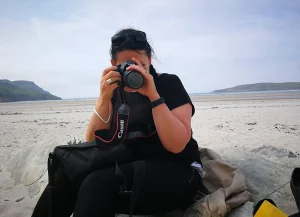
Turning the Camera on Myself
Originally, I planned to photograph different people living with mental health conditions.
Then one of my lecturers asked a simple question:
“Why not photograph yourself?”
That question stayed with me.
I’ve always been open about living with bipolar disorder, so I decided to document my own journey over the course of a month. I photographed myself through the different mood states, capturing both the difficult lows and the brighter periods.
Some days it was incredibly hard. When I’m depressed, I often freeze and struggle to do even the simplest tasks. My husband would gently encourage me to pick up the camera on days when he could see I had no motivation at all.
Looking back at the photographs could be confronting. I often found myself asking, “Do I really look that unwell?” and wondering how I would ever move beyond that state.
But, as it always does, the depression eventually lifts.
When my mood stabilises—not too elevated, but balanced—I feel like myself again. Everything becomes more achievable, and even physically I look different. Those are the weeks I long for.
I often describe living with bipolar as trying to balance on a seesaw—constantly adjusting, always searching for stability.
More Than a Photography Project
Throughout the project, I wondered whether people might feel uncomfortable with the subject matter.
Instead, I found the opposite to be true.
People were curious to learn more about bipolar disorder, and many told me they admired the openness and vulnerability of the work. That response reinforced one of my hopes for the project: to raise awareness, encourage conversation, and help others better understand what living with bipolar can be like.
The process also became one of self-reflection. I have a feeling that Tides Within is only the beginning and that the project will continue to evolve.
I’m grateful to AWARE for giving me the opportunity to share this work. I also want to mention the AWARE support groups for people living with Bi-Polar which are a key element in addition to my photograph for my self care. Having the opportunity to share my concerns, worries with a group of people also living with Bi-Polar is a special thing and a really powerful support mechanism. Facilitated by Aware volunteers who are amazing and probably dont even realise the impact their work is making on us all.
Photography as a Lifeline
Photography has become my mindful practice.
When I’m behind the camera—and later when I’m editing the images—I’m completely present and focused. It has become much more than a creative outlet; it has been a lifeline.
Although the NCAD course has ended, my photography continues, and so does my journey.
Below is a small selection of images from Tides Within.
~
Read more about Aware Mental Health Week here.
~
Empowering people to look after their mental health is an important part of Aware’s supports including our Living Well with Bipolar Programme. A free service delivered by a mental health professional, designed to empower participants by deepening their understanding of bipolar and helping to identify personal triggers for mood changes – this programme provides a strong foundation for thriving with bipolar. Registrations for the next course and more details available here.
For those friends and family supporting a loved one experiencing bipolar or depression, Aware also offers a Family and Friends Support Programme, a psycho-educational programme providing information, understanding and practical support. The free programme aims to equip participants with the tools to better understand and support a loved one, whilst maintaining their own wellbeing. Registration and more information available here.